Driveway Replacement Cost in Surrey 2026: Concrete vs Pavers
A straight comparison of paver, poured concrete and asphalt driveways in Surrey for 2026, with real cost ranges and what the base work involves.
We're Adam and Ben, and we build driveways out of South Surrey with our own crew, trucks and compaction equipment. A driveway is the largest hard surface on most properties and the first thing anyone sees, so getting the material and the base right matters more here than almost anywhere else on the lot. Here is how we price driveway replacement in Surrey and the surrounding cities in 2026.
Pavers, poured concrete or asphalt: which is right for a Surrey driveway?
Interlocking pavers are what we install most. They flex with ground movement instead of cracking, individual units can be lifted and replaced if a section settles or a utility needs to be reached, and the finished look is the best of the three. In Greater Vancouver a paver driveway costs $25 to $45 per square foot installed, which is a typical range for our market.
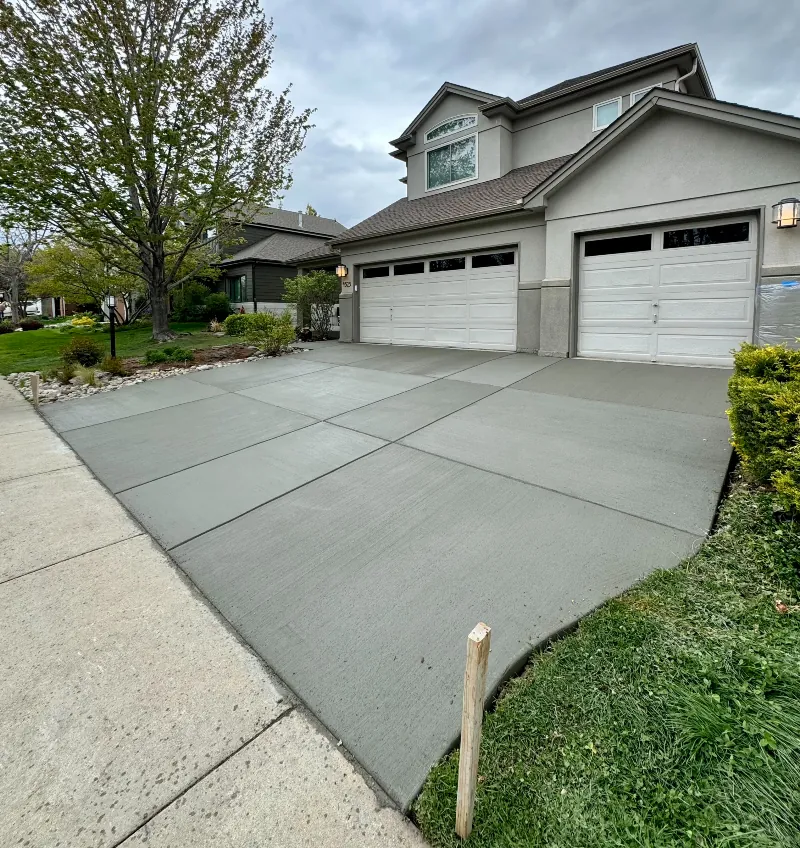
Poured concrete is the middle option, typically in the range of $12 to $20 per square foot installed here depending on thickness, reinforcement and finish, with stamped or coloured work costing more. It is a clean, solid surface, but it is rigid. On clay subgrade with seasonal movement, concrete eventually cracks, and a cracked slab is patched, not repaired invisibly.
Asphalt is the cheapest to install, usually well under concrete per square foot, and the fastest. It also has the shortest life and needs sealing every few years, and it softens in a hot week. We see it most on long rural driveways where the square footage makes the other options impractical.
Our honest recommendation: if you plan to stay in the home, pavers are the option you stop thinking about. If the budget is tight and the shape is simple, well-built concrete is a reasonable call.
Why a paver driveway costs more than a paver patio
Same product, very different build. A patio carries people and furniture. A driveway carries vehicles, and in this region that increasingly means a heavy SUV or an electric truck that weighs considerably more than the cars driveways were built for twenty years ago.
For a patio we build a 6 to 8 inch compacted base. For a driveway we go to 10 to 12 inches of 3/4-inch minus road base, sometimes more where the subgrade is soft, compacted in lifts and proof-rolled. That means deeper excavation, more spoil hauled away, more base stone imported, and more machine hours. The pavers themselves are also thicker: 80 mm units rather than the 60 mm we can use on a walkway. Edge restraint is heavier duty, and joints are locked with polymeric sand.
So when you see the same $25 to $45 per square foot range quoted for both, understand that a driveway usually lands higher inside that range than a patio of the same size and finish, because of everything underneath.
Worked examples
A standard two-car driveway of about 500 sq ft in pavers typically comes in around $14,000 to $22,000, including removal of the old surface, full base build, edge restraint and jointing. A simple concrete replacement at the same size generally lands around $6,000 to $10,000, plus removal.
A longer driveway with a parking pad or turnaround, call it 900 sq ft, runs roughly $25,000 to $40,000 in pavers. At that size the per square foot number often improves slightly, because mobilization and setup are spread over more area, but a steeper grade, a retaining edge or a drainage requirement can pull it back up.
Removal of the old driveway
The old surface has to come out before anything goes in. Breaking out and hauling old concrete typically adds a few dollars per square foot in our market, driven by thickness, whether there is rebar or wire mesh in it, and how easily a truck and machine can get to it. Asphalt removal is usually cheaper than concrete. We recycle what we can. On a full replacement we also take the opportunity to check the subgrade, because a driveway that failed early almost always failed from below, and repeating the same base is how you get the same result twice.
Permeable pavers and stormwater
Permeable paver systems use an open-graded stone base and wider joints filled with clear chip so rainwater passes through the surface and into the ground instead of running to the street. They cost more than a standard paver driveway because the base stone and installation are more specialized, but they can be the right answer on lots with drainage problems, on properties where the municipality is asking for on-site stormwater management, or where you simply do not want a river down the driveway every November. They also need occasional joint maintenance to stay permeable, which we walk homeowners through.
Permits and work in the road allowance
The section of driveway between your property line and the road, including the crossing over the sidewalk or boulevard, usually sits in the municipal road allowance and is treated differently from work on your own land. Requirements vary between the City of Surrey, the Township of Langley and every other municipality out here, and they change. The short version: check with the municipality before touching that portion, and we handle this on every driveway job. We confirm what applies to your address, arrange what is needed and build to the standard they require.
What we see on Surrey, Langley and White Rock jobs
Clay is the theme. On a lot of Surrey and Langley driveways we excavate and find a thin layer of gravel sitting directly on soft clay, which is exactly why the old surface has ruts, dips or a sunken apron near the garage. Those jobs get fabric and a deeper base. In White Rock and South Surrey we deal with slope instead: driveways that pitch toward the garage need a trench drain and a real plan for where the water goes, or the base will be wet all winter no matter how well it was built.
The other recurring one is downspouts and perimeter drains discharging under or beside the driveway. Water is what moves base material. We reroute it during the build rather than hope.
Timeline
A paver driveway of typical size is usually three to six working days on site: demolition and haul-out, excavation, base placement and compaction, laying and cutting, then edge restraint and jointing. You can drive on it the day we finish. Concrete is faster to place, roughly two to three days of work, but needs about a week of curing before vehicles, and longer in cold weather. Add time on either for drainage work or municipal coordination.
Maintenance
A paver driveway wants very little: rinse it, keep the joints topped up with polymeric sand every several years, and address any oil spots reasonably quickly. If a section ever settles, individual pavers lift out, the base is corrected and the same units go back down, which is the practical advantage over a slab. Sealing is optional and mostly about colour. Concrete wants crack sealing and control joint maintenance. Asphalt wants sealing on a regular cycle.
Every driveway we install is backed by our 1-year workmanship warranty, so if something we built settles, shifts or fails within a year, we come back and fix it.
If you are ready for a real number, we will come out, measure the driveway, look at the grade, the access and where your water goes, and talk through pavers versus concrete honestly for your situation. The on-site estimate is free, and you will have an itemized written quote within 24 hours.
Ready to Transform Your Outdoor Space?
Get a free estimate from Northwood Landscaping — serving Vancouver, Burnaby, Surrey, Coquitlam & Greater Vancouver.